University of North Carolina Athletics
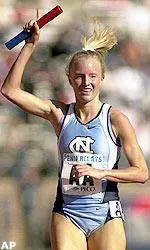
THM Archives: Flanagan is 2003 Tar Heel of the Year
June 29, 2004 | Track & Field
June 29, 2004
One of Carolina's best athletes, Shalane Flangan, announced her intentions to turn pro Tuesday. What follows is a story that originally appeared in Tar Heel Monthly in July of 2003.
By Adam Lucas
In the minutes before a race, Shalane Flangan evaluates the competition.
That girl won an Atlantic Coast Conference title. That girl looks scared. That girl looks more fit since I saw her last year, keep track of her.
Track and field is an insular world, so the rising Tar Heel senior knows at least something about all her competitors, if not personally, then by reputation or by the accolades they have received. She usually knows before a race how competitive it will be, and she has a general idea of what kind of performance it will take to win the event. She knows her race strategy, and she knows which runners are fast starters and which are likely to finish strong.
But it's the other runners who know something that Shalane Flanagan is only beginning to realize. They've run against her, they've tried to compete with her, and more often than not, they've lost to her. It's the other runners who know that of everyone assembled on the track in the minutes before a race, there is only one individual who in a college track meet should be feared by Shalane Flanagan.
And that individual is Shalane Flanagan.
Shalane's father, Steve Flanagan, was immune to the whining. A collegiate track runner at the University of Connecticut and former training partner of Frank Shorter, an Olympic marathoner in 1972 and 1976, the elder Flanagan would take his daughter on runs around the block when she was young but wouldn't let her train intensively. She'd beg to go on longer runs. He would decline. She'd plead to step up the distances. He would decline.
But he had other ways of building her endurance, other ways of watching her develop into the stellar distance runner that he had already seen signs that she could be. A basketball, baseball, and football letterman in high school, he had a unique view on how to mold a competitive runner.
"I had the advantage of being trained as a teacher and observing other talented kids in a variety of sports during my teaching," he says. "Kids don't like to train. They like to go out and play. That's the problem with parents who have kids with track talent and make them train. It's no fun to train. You have to manipulate the workouts so they're having fun."
So Shalane Flanagan, who was named after a heroine her father recalled from a book he read in high school, played soccer in her hometown of Marblehead, Massachusetts until she was a freshman in high school. She swam until she was a senior in high school. And running? It wasn't more than an afterthought, just something you did during a soccer game to control the ball.
"My father really held me back in terms of running," she says. "Most people are amazed by that. He kept emphasizing that if I really liked running, I had a lot of time in my life to be a runner."
So she dedicated herself primarily to swimming and soccer. Shalane wasn't a naturally gifted swimmer, and sometimes finishing third was an accomplishment.
But it was on the soccer field where she showed the first hints of the athletic success that was to come.
"I used to coach her soccer teams," her father says. "It would be late in the second half, and she'd still be sprinting to the ball and be comfortable. She still had something left at the end of the game when other kids were looking to be taken out of the game. From the time she was seven or eight, she had that natural endurance. I wanted to keep it inside, but I would bubble with excitement underneath."
The bubbling finally overflowed when his daughter reached middle school. Almost on a whim, she tried out for the seventh-grade track squad at Marblehead Middle School. She didn't train much, didn't have much time to spend on the sport between her commitments to soccer and swimming, but the natural aptitude was undeniable.
And then, suddenly, everyone else saw the aptitude and it was no longer a secret. It came during a middle-school track meet at Gloucester Middle. Gloucester, about 20 miles up the Massachusetts coastline from Marblehead, is known primarily for whale-watching and for being the setting for the Sebastian Junger book "A Perfect Storm." The ill-fated ship Andrea Gail left from the Gloucester harbor in 1991, just four years before a pair of nondescript middle schools gathered for a track meet.
For track aficionados, Gloucester was known less for shipwrecks and more for a rising star named Tristan Colangelo. Currently a distance runner at Princeton University, Colangelo in those days was somewhat of a running prodigy. He would later run a phenomenal 4:12 mile as a senior in high school, a time that would place him among the very best boys high school milers in the nation in that age group.
Ordinarily, the boys and girls would run separate events. But to save time, the Gloucester and Marblehead coaches agreed to let the boys and girls run together in the mile. Being experienced track observers, the coaches knew exactly what would happen: the runners would separate into two distinct packs, boys in one faster group and the girls following behind by about a minute. It wasn't sexist. It was a simple truth of physical capabilities.
Except that one girl didn't seem to be constrained by physical capabilities.
"Shalane took off and led after one lap," says Steve Flanagan, who witnessed the four-lap race. "She led after two laps. In the fourth lap, Tristan finally caught her. When he caught her, she responded right back, and he had to kick like crazy over the last 100 meters just to beat this junior high girl. Years later I would go up to Tristan and say, 'You haven't had to outkick any girls lately, have you?'"
Now Massachusetts didn't have just one running prodigy. Now there were two, and the other was the blonde-haired girl from Marblehead.

 |
|
Runners tend to be drawn to other runners. Everyone likes to be around people with similar interests, of course, but it's even more intense for runners.
"There is definitely such a thing as running nerds," Shalane Flanagan says.
And why not? Who else could understand the drive to run endless miles with no particular destination on the horizon better than someone with that same drive?
So it's no real surprise that Franklyn Sanchez and Steve Flanagan would eventually cross paths. Sanchez was a junior in high school, an accomplished middle-distance runner who now competes for Georgetown. He was running through Nahant Beach when he crossed paths with the elder Flanagan. Being runners, they made plans to do what runners do--meet the next week to go running.
Flanagan brought Shalane, who was also a high school junior, with him the next Sunday morning. Sanchez recognized her immediately. He had watched her run a cross country meet at Franklin Park, where she holds the state cross country record, the year before. Predictably, she won that meet easily, prompting Sanchez to try and approach her to ask her about her training methods. Flanagan was surrounded by media, however, and so the pair didn't speak until that leisurely Sunday morning run.
Their training together eventually became a ritual. Pound out several miles on Sunday morning, then return to the Flanagan house for pancakes.
"He worked harder than I did," Shalane says. "He made me realize what hard work could do. He was very humble, and he made me realize that you could be humble and also be good."
Her training partner, meanwhile, was realizing something else.
"What I love and truly admire about Shalane is that she is not afraid," Sanchez says. "She does not fear anybody or anything when it comes to competition. She is tougher than Steve Prefontaine and any other top runner in this country, men or women. As a matter of fact, she can be her own worst enemy sometimes. She should be afraid of herself. That's how competitive Shalane Flanagan is."
Sanchez couldn't know it at the time, but Flanagan would eventually prove him exactly correct. She chose to attend Carolina only after a protracted recruiting battle that saw the Tar Heels, an upstart in the distance world, have to fend off most of the distance-running college powerhouses.
"Trackwise, I thought of Carolina more along the lines of Marion Jones or Allen Johnson," Flanagan says. "I thought it was more of a sprinting and hurdling type school. But Coach Whittlesey was pretty persuasive in getting me to come for a visit."
"I had seen her results and thought they were pretty impressive," says Michael Whittlesey, Carolina's cross-country coach and assistant track coach. "From a results perspective, she wasn't the number-one high school senior at that time. But I had seen her race as a junior. She didn't even win the race, but the way she ran you could tell she was stronger and more untapped than the other athletes. I thought she was someone who could put our program at a higher level."
Flanagan fell in love with Chapel Hill and spurned Villanova, among others, to become a Tar Heel. A three-time All-State performer in cross country in high school, she arrived at Carolina with a strong preference for cross country over track.
To outsiders, the preference might seem strange. After all, it's all running, right? What's the difference?
"Cross country is completely different," she says. "A lot of people don't know much about it, but those who run it are absolutely infatuated with it. In cross country you're out there on a golf course or somewhere and it's pretty long, 2.6 miles. It's a long time to keep your focus for a race. You're not just running around in circles and there are crazy fans out there. There are a lot more terrain type situations and a lot more variables involved."
"Cross country is not a sport about who is fastest, but about who is toughest," Whittlesey says. "It's about who can handle the pain the longest. And you don't get much tougher than Shalane Flanagan."
So it was only natural that Flanagan would excel in intercollegiate cross country. Her freshman year, she finished fourth at the NCAA Championships in Ames, Iowa, clocking a time of 20:42.7. She was named a cross-country All-American and ACC Performer of the Year.
That was just a prelude to her sophomore year, when on the evening before the NCAA cross-country championship, she was selected the Division I Cross Country Athlete of the Year. That made her the overwhelming favorite to claim the national title at the event, which was held in Greenville, SC.
Warming up before the race, however, it was obvious that something was wrong.
"Her pulse rate was 130 warming up," says her father. "Some nervousness is good, but that's too much. You want to be somewhere around 100."
Despite the nervousness, Flanagan blew out to an early lead. She ran the way she thought you had to run in order to win a national race--hard. Hard at the beginning, hard in the middle, hard at the end. But her early lead turned out to be too big. She had overexerted herself and had nothing left physically for the final stage of the race. Just as Sanchez had observed two years earlier, she was her own worst enemy. Completely tapped out, she finished a disappointing 19th.

|
|
"She started running away from people in the middle of the race," Whittlesey says. "She expected that to win an NCAA championship you had to run as hard as possible. She made a move and didn't need to, and she ran herself into the ground."
For plenty of runners, the story would end there. Overwhelming favorite suffers heartbreaking defeat, career goes down in flames. It's happened before and isn't even all that unusual, both in track and in other sports. Sometimes, the pressure is just too much, the stage is too big, the lights are too bright.
Some athletes can continuously put together winning performances as long as they're not the favorite, but cast them in the role of the expected winner and they fall apart. There were whispers that that might be the case with Flanagan. Can't handle the pressure. She'll never reach her potential.
The only person who didn't seem concerned about the future of her running career was Flanagan. But the only way to prove the naysayers wrong was to capture this year's national championship. She sat for a few sessions with a local sports psychologist, working on ways to mentally approach big races.
And then she proceeded to blow away the rest of the NCAA. At this year's national championships, she blistered over the Terre Haute course in a course-record of 19:36, which shattered the previous mark by almost 20 seconds, claiming Carolina's first national title in the sport. After the race, she accepted her second straight Athlete of the Year award.
"I knew the potential I had when I was a sophomore," she says. "But I might not have been mentally fit enough to take all the pressure I was putting on myself. That experience made me want to win more. It was essential for me to lose last year in order to be able to win this year."
"That was the epitome of her career," says her father. "She was the best collegiate cross-country runner in the country her sophomore year, but she defeated herself with her race tactics. To come back a year later and continue to be the best and not be denied is unbelievable."
Winning seemed to agree with her. Two weeks after winning the national title, she captured the Honda Award as the top female cross country runner in the nation. In March, she won two more national titles, capturing the NCAA indoor 3,000 meter title with a time of 9:01.05 and combining with Erin Donohue, Anissa Gainey, and Alice Schmidt to win the NCAA indoor distance medley relay crown. She has twice set the ACC mark in the 1,500 meters (her best time is 4:11.60), bettering a record that previously stood for 19 years.
Three years at Carolina, three national championships. Only one individual athlete in Tar Heel history, swimmer Sue Walsh, has more than three national titles, and Flanagan, who is majoring in history after discovering an affinity for the subject by taking several classes in that field at Carolina, could still add to her place in history on June 11 at the NCAA outdoor championships.
She won't, however, win any indoor or outdoor national titles next season. If her current plans hold, she will complete her cross country eligibility in the fall and then redshirt for the indoor and outdoor track seasons in order to train for the Olympic trials in either the 1,500 meters or 5,000 meters in June of 2004.
"I've never wanted to say I would do something if I didn't really think I could do it," she says. "My freshman year, I mentioned to Coach Whittlesey that I wondered if I could redshirt my senior year to get ready for the Olympic trials. I think we would've modified that plan if I didn't have a prayer of doing it, but I've progressed pretty steadily and it's realistic, I guess."
The 2004 Olympic games will be held in Athens, with the American trials contested in Sacramento. Between now and then, she'll try to hone her 5,000 meter abilities, as she has only contested two of those races in her career.
"A lot more focus goes into the 5K," she says. "You're out there for 3.1 miles. I try to block it out and then hopefully look up and there's just a mile left and it's time to race. But the 1,500 is just go, go, go. I pretty much go all out from the gun and find a pace."
efore the Olympics, however, she still has one more occasion to set the pace for the Tar Heels. She came to Carolina to help the distance program reach the nation's elite, and since she arrived her stated goal has been to win a team national championship. The women's cross-country team placed 21st in 2002 and seventh in 2001, so they're in position to challenge perennial power BYU for the team title.
Just moments after winning her individual cross country championship this year, just moments after vanquishing that one opponent observers thought might topple her, she was already thinking of 2003.
"As soon as she crossed the line this year at the cross-country championships and we celebrated her victory, she turns to me and goes, 'Next year, the team,'" Whittlesey says.
It would only be fitting if she did help the Heels capture a team championship--after all, it's virtually the only award she hasn't already won. She's been in Sports Illustrated, she's won the Honda Award, she's got a stack full of ACC awards. Some of them she sticks under her bed, some are sent home with her parents when they come to visit. She only displays the trio of national championship trophies and the Honda Award, plus the baton from this year's Penn Relays, where she, Donohue, and Schmidt combined to win three different relay championships in front of a combined crowd of over 100,000.
ut ask her which of her honors make her proudest and you'll get a surprising answer.
"Every time you're honored for something it makes you feel good about yourself and I'm happy to represent my school," she says. "But the best one I've received was this year in the Daily Tar Heel, I was voted this year's female athlete of the year. That was really amazing to me, because it's voted on by students and I have no idea if people know who I am on campus. I was just really amazed that people voted for me. Being in Sports Illustrated is cool, but to me the students appreciating what I do is better than Sports Illustrated."
With that, our 2003 Tar Heel of the Year seems to be passing along the lesson she learned four years ago from Sanchez, her training partner: it's OK to be good. But it's even better to be humble and good.
She's plenty humble, like when she asks a writer if he thinks there's a chance Roy Williams--who still needs two more national titles to go with his 1982 ring in order to equal Flanagan--might attend a cross country meet this fall. But these days when she surveys the competition before a big race, she doesn't find the opposition nearly as tough as it used to be. She's learning that as a runner, very few athletes can beat Shalane Flanagan.
Even Shalane Flanagan.
Adam Lucas is the publisher of Tar Heel Monthly and can be reached at alucas@tarheelmonthly.com. To subscribe to Tar Heel Monthly, click here.